Tuesday, February 6, 2018

Suffering and the Beauty of Failure


I've found that I don't write about successes nearly as often as failures. In truth, I don't like the successes as much--they're not as inspiring as the failures. Failing means I stuck my neck out; I tried something beyond what I "should have" tried. Failing means I pushed my boundaries, not just beyond what I perceived I was capable of, but beyond what I actually was. I like that.
“The Edge...There is no honest way to explain it because the only people who really know where it is are the ones who have gone over. The others-the living-are those who pushed their control as far as they felt they could handle it, and then pulled back, or slowed down, or did whatever they had to when it came time to choose between Now and Later. But the edge is still Out there.” -- Hunter S. Thompson, Hell's Angels: A Strange and Terrible Saga
When I succeed, it means I didn't think big enough--that I wasn't willing to find the edge, I only know that it's still Out there, somewhere "further"--and all I've done is figure out that I need to find something bigger to fail at. But everything Out there takes so much time, or carries some deeper intrinsic risk, so instead, I try to make the old stuff just a little bit harder.


Which is all a way to say that I'm not training much.

I mean, I never trained much to begin with, honestly--but now I train even less (Scott Kummer and I talked about this in our nearly-4-hour nobody-will-listen-to-the-entire-thing episode of Ten Junk Miles). The surprising thing: I haven't found not-training to be overly burdensome. To the contrary, it's quite freeing--enjoyable even.

2017 was my year of no training. I don't know that I can push it much further. Granted, I failed at Zumbro 100, but I finished Tuscobia 160 (twice, technically), Superior 100, and the Barkley Fall Classic--none were easy, but they weren't supposed to be.

A friend suggested we run a race, then grab a chair right before the finish line and sit there, just outside the timing mats, until cutoff--just to highlight the absurdity of it all. It's taking power back from these events, which isn't so different than doing a course within race rules and under cutoff, just not on race weekend--the polite bandit (the only way some get to run certain events).

'Postmen of the Wilderness' by Arthur Hemming

I've found that I like people that do winter events. I don't mean, like, go out and do a 10-mile run at -20F. I mean those that voluntarily go out and suffer for 3 days in the cold and snow, pulling an absurd (yet possibly quite necessary) amount of survival gear, for little to no actual reason. There's something about this silly amount of shared voluntary suffering that brings people together, even more so than in long summer events.

I've also found that every Calvin & Hobbes sledding strip is directly applicable to winter ultra events.


The best and kindest people I know have all suffered--be it voluntary or involuntary, physical or mental. I think suffering (voluntary or involuntary) makes people more attune to others' suffering (voluntary and involuntary). (Anecdotally, there are more vegans/vegetarians in this sport than other cross-sections of society.) I often say that, to finish these events, you have to find meaning in the suffering. There's a race (that shall not be named) with the motto, "Needless suffering without a point"--but maybe there is (or always was) a point. Maybe we're all better for it. Maybe the suffering makes us better people; not better than others, but better than our prior selves (or prior notions of self).

27 people started the 2017 v.2 Tuscobia 160 on foot. There were 47 registered, but the forecast turned cold, and a lot of people didn't show up. 6 finished.

Dare I say--it was a bit routine.

I mean, it was hard, but it was supposed to be hard. I'd gone over all the possibilities in my head prior to the race, and had either accepted the painful and terrible things that were going to come, or had prepared a solution for them (everything but beyond-basic injury). My hands were cold, but they're always cold. My feet hurt, but they always hurt eventually. My legs were cold, but that hardly matters. It took a long time (61 hours), but it was always going to take a long time. I wasn't going to win, but that's OK. The end seemed to never get there, but your brain does that at all of these races.

I never got too cold, or too far down. I could have run if I needed to--but I didn't need to. I could have stopped and eaten warm food that last possible time at Gateway and warmed up inside, but my kindred companion was too low to leave the trail, fearing never coming back out, so we kept on.

The thing I didn't expect: my deep and still-growing appreciation for these fellow sufferers, gracefully persevering right along with me--for seemingly no reason at all.

Why did we climb it? Because it was there.


But really, Paul Schlagel was in front of me, and not only did he do the Order of the Hrimthurs last year (and is 2/3 through again this year), but he did Moab 240, with ITI 350 as his reason for doing so (I too have ITI 350 in sight, but I doubt I want it more than Paul--the event, and the required time off from work, still scares me--maybe another year). I was in no hurry to try and catch him (not that I could have). And when I caught Dominique LaSalle after he stopped for 2 hours to take care of a biker in trouble at -25F just before the third morning, I wasn't going to leave him. That's my race. Simple as that. Dominique and I got 2nd. (I love that man. He said he's going to volunteer next year, but I don't believe him.)

You first, Paul.

The highlights of the race for me were arguing with Dominique and Logan Polfuss the first morning of this pointless thing--Logan and me screaming back and forth about tyranny, human behavior, and the common good--listening to Dominique belt out "I am the Model of a Modern Major General" at -20F in the middle of the second night, and Logan taking a 3+hour detour on his way home, just to have lunch with us. It all runs together--as if time floats away. We remember the highs and forget the lows, much like in life. We wrestle with our existence, and our reason for being. It changes us, or rather, we're the same people--the world is as it was--we just see it differently.
"People will forget what you said, people will forget what you did, but people will never forget how you made them feel." -- Maya Angelou
I think what draws and keeps me is the suffering, and the time devoted to a single task, where everything else in life doesn't matter--it all disappears. I only want to see my people, not because I need them, but maybe just to know they exist--that they're still here--that I'm still here. Because there is no guarantee they will be, or that I'll get there.
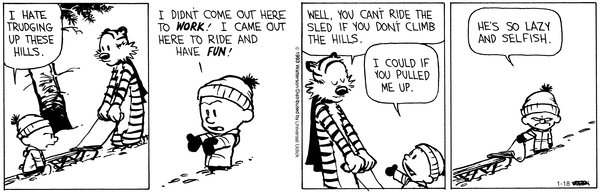
I've had this same conversation with Alex, but lying on the back of her sled.

You can't lie to yourself in these events. I know I've said that you should lie to others about how you feel ("When people ask you how you feel, and you actually feel horrible, lie to them. Tell them you feel great."), but I don't think that's actually lying to yourself--it's more just shifting your perspective. We have a normal range of comfort, and these events don't fit in that normal range--which actually means that, in your daily life, what you find uncomfortable probably isn't discomfort, in the grand sense of comfort. It's not that others have it worse, or have suffered more, but that your perspective is incomplete. These are paradigm-shifting events, and we're better for them.

We're better for the suffering--that shift in perspective expands your capacity for compassion, for kindness. Do enough of these, and your ego will be beaten down to the appropriate level of nearly non-existent. The hard, cold truth of the matter is that we're not special--we're not superior athletes, gifted with anything extraordinary--most people could do these things--we just suffered, and kept going. When we fell, we got back up. We've tried things above us, and we have failed. Then, we figured out why we failed, and tried again--and that's beautiful, but it's not unique to this sport.
"When I was young, I admired clever people. Now that I am old, I admire kind people." -- Abraham Joshua Heschel 

All the best people I know have really suffered.
"What matters most is how well you walk through the fire." -- Charles Bukowski
The better you know it, the more you appreciate the suffering of others. You know that sometimes you can overcome it, but other times it'll be too much, and you'll fall apart. And the harder you hold on, the harder you'll fall.
"Everything I've ever let go of has claw marks on it." -- David Foster Wallace, Infinite Jest
Because we didn't fail today, doesn't mean we won't fail tomorrow. There's an amount of arbitrariness in life that we cannot escape. There's only so much we can control. The rest, we give into. We're just along for the ride. Appreciating that, the arbitrariness of it all, is humility. The world needs more of that.

We just get it in 100+ mile chunks.


Thursday, January 14, 2016

Decompressing Tuscobia

I've been writing an injury-free running post for a while--it's a bit long, kind of an essay on running, actually. I don't know if it's good or bad that I didn't finish and post it before Tuscobia, seeing I've left that race injured two years in a row.

Gotta fix that.

Tuscobia is a wonderful event, put on by wonderful people, Chris and Helen Scotch and a slew of selfless, passionate volunteers.

I'm not a sailor, but winter ultra events remind me of sailing. There's a minimum complexity--if perfect weather and conditions, they're summer events with added gear. At best, it's a long, slow haul across the ocean. The perfect race is one of few waves and constant, steady progress. But like the unimaginable power of the ocean, weather and trail conditions can take what was a peaceful journey and turn it into madness.
"A ship is safe in harbor, but that's not what ships are for." ― William G.T. Shedd
Like walking a slackline, high above a canyon floor--it's that slim path of safety so close to danger on each side that draws people to it. It's climbing, one missed hold away from falling. It's about controlling what you can, and giving in to what you cannot.

I didn't know I was a thrill seeker.

Though my safety net is a bit safer than others--a sleeping bag and a spot device.

The race

The race started off well-enough, except that I accidentally found myself in front. I didn't even put on a headlamp until just a minute before we took off, and I hadn't planned on turning it on unless I needed something from my sled, yet somehow my 16-minute pace was leading. There was a few inches of new, wet, unbroken snow on the trail as we left Rice Lake, and it started snowing more as we headed north to the Tuscobia trail. I expected some idiot to run by at some point, but alas, I was the biggest idiot for the first 5 miles, breaking trail, until it got light.

When Scott Hoberg and I made quick stops a bit onto the Tuscobia trail, Carla Goulart and Kevin Alldredge scooted by for a second. They tried to sled the first hill, but didn't slide far, and Scott and I pulled ahead, Scott breaking trail for the next spell. At some point, Grant Maughan, from Australia, and Carla went ahead, running a bit. Scott followed, keeping them in sight. Even Kevin went ahead as I stayed at my 16-minute pace. Then, as the trail got hilly before Birchwood (mile 18), I kept pace past Kevin and Carla, before stopping at the first gas station for the bathroom and liquid.

I came back out to see Kevin and Carla just ahead, then Scott and Grant, who must have stopped at the second gas station. Still nobody in sight behind us. I made my way past Kevin, Carla, and Grant, and caught up to Scott. We had wonderful conversation, taking turns breaking trail. Grant stayed with us as Carla and Kevin fell off. Around mile 36, Scott stopped to check his feet, and Grant started running a bit. Scott went after him, and that's the last I saw him until mile 74.5. Grant eventually pulled out of sight, but he was at Ojibwe (mile 47) when I got there, and I left just after him.

I told Alicia, at Ojibwe, that I wanted to go quick, because I didn't want my right leg to tighten up--a sign of things to come. The night was uneventful, and lonely. The weather was good, and the trail ok. I was following Grant and Scott's steps, but was alone most of the night. My pace started to drop around mile 60--a combination of the pain in my right leg and sleepiness. The lone remaining 150 skier, Dan Powers from Alaska, caught me not too much afterwards, and I had new tracks to follow.

As the miles went on, the pain kept building in my right leg behind my knee. I wasn't able to fully extend it, or use my right calf or hamstring, but I could still push with my glute at a decent pace, so I kept on. A similar pain developed last year, though later in the race, and I was able to finish. I figured as long as I was able to keep my pace up, I'd be fine.

Soon, a single light started at me in the darkness, and Scott was on me. We talked briefly. He'd picked up the pace when he took off before Ojibwe, and hadn't slowed. At mile 74.5, he was 11 miles and a 45-minute break ahead of me. Amazing.

I got to the turnaround at Park Falls, mile 80, at 8:30am, 25.5 hours into the race. Dan, the 150 skier, and Grant, the Aussie, were sleeping. I fixed my feet, grabbed some warm water, and put my feet up for a few minutes. I took off again, just after Grant, but the right leg was slowing me a lot.

And that's about it.

I got back out on the trail and struggled to maintain a decent pace. It was ok, right away, especially as I passed the other 150-mile runners headed to the turn-around, and it wasn't long before the 75-mile bikers, skiers, and runners started by.

I had to put my parka on early because I couldn't keep my hands warm, then the wind picked up after dark, and the temps kept dropping. I told myself, "I can do this," a billion times, and I believed it, for a while, but the pain kept building, and I kept slowing down. Every few steps, my leg would move in a way it shouldn't, and the pain would blur my vision. I was tired, but the pain was exhausting.

At this point, around mile 103, I'd been moving at a paltry 27-minute pace the 23 or so miles since Park Falls, and I kept slowing. Doing the math, I'd be fine with even a 30-minute pace to the finish, but I couldn't fathom 26 more hours of wincing, vision-blurring pain. I came to a road crossing and checked my phone. No service. I kept going.

Logan Polfuss caught up, and I wasn't alone anymore. It was nice. We chatted a bit about the race, and life, and a few slow miles went by, but I was quickly losing the will to go on. We were 105 miles in, some 9 miles out from Ojibwe, and 4 miles from Winter, but I was done. The next road crossing came up, and I hit my non-emergency "come get me" button on my Spot device, tossed my sleeping pad out in the snow, pulled out my bag, and laid down. Logan joined me.

It was glorious.

Alicia and Kerry came and picked us up 3 hours later, and we crashed at a hotel in Winter.

By the time I woke up, Scott Hoberg had finished, and we made it to Rice Lake the next day in time to see Grant, the Aussie, finish. John Taylor and Thomas Keene, from Tennessee, each hung on to finish. 4 of 23 finished. The rest of us swung and missed, but that's ok, too.

Next time.

Tuesday, November 10, 2015

The greatest lesson

He was born on a little farm in Wisconsin, a surprise as much to him as me.
He picked us, and that was the beginning and end of everything.

He went amazing places, and none of them mattered.
It didn't matter what we drove, where we slept, where we were going, or what we wore.
It only mattered that he was with us, and not without.

He taught us that happiness isn't a place, it's not a destination, or a thing, but a journey, only defined by who you travel with.

Travel anywhere, or nowhere at all, but do it together, and you have everything.

Tucker Sandor
December 5, 2004 - October 29, 2015


I wrote the below in September, after we learned we were losing him.
I'm thankful for every moment.

He was born on December 5, 2004.
He picked us in February, 2005; he wouldn't let us leave without him.
We walked him off leash right away, before he could even get away if he'd wanted to; he's never needed one since.
We learned quickly that he can't do kennels, but that hardly ever mattered.
When he was 2, he got a brother.
When he was 7, he lost him, and it was heartbreaking; he didn't understand what happened, and for months, he looked for him everywhere he went.
When he was 9, he got another brother.
He started as our pet, became our son, and over time, has become something even more than that; he's given us more than we've given him.
He's better and more compassionate than I am; I still learn from him every day.
He loves to travel, and hates being left behind.
He's been to 29 states.
He's seen Yosemite, Mt Whitney, and Death Valley.
He's been to Frozen Head in Tennessee, to Arrowhead and Tuscobia, to Leadville, Hardrock, and Western States.
He's climbed mountains, and strolled through Central Park.
He's seen Gettysburg, Niagara Falls, and Zion.
He's swam in Lake Tahoe and Superior, the Colorado River, Mississippi, Minnesota, and St Croix.
He became the wary acquaintance of a buffalo in Yellowstone, and picnicked at Jackson Lake under the Tetons.
He's hiked the Badlands, and Arches National Park.
He's walked through Times Square, and been on the Las Vegas strip.
He's run on the salt flats in Utah, and hung out in Colorado bars.
He's paddle boarded, kayaked, canoed, and boated.
He's spent countless nights and weekends with me in my office at work.
He knows when we're sad, and when we need someone to just be there.
He's the best friend I've ever had. 
And he's dying.
And there's nothing we can do. 
We've always known we wouldn't get to keep him forever.
Like everything else, he was never really ours.
But even though we know we'll have to say goodbye, we don't want to.
We never want to. 
But he has an aggressive form of cancer.
It's everywhere.
And he's tired.
And he's scared.
And soon, his pain will be heavier than his hope.
And we'll have to let him go. 
We don't know how much time he has left, when the days will become more bad than good.
But we do know how much he means to us, and that we owe it to him to keep his best interests in mind, and not be blinded by our own. 
And we are sad.
And we are heartbroken.
And we will get worse.
And we will eventually be OK, but right now we're not. 
We just want his last few days, or maybe weeks, to be wonderful.
Because what he's given us is beautiful.
And we wouldn't trade it for the world.