"To live with sincerity in our culture of cynicism is a difficult dance — one that comes easily only to the very young and the very old. The rest of us are left to tussle with two polarizing forces ripping the psyche asunder by beckoning to it from opposite directions — critical thinking and hope.
"Critical thinking without hope is cynicism. Hope without critical thinking is naïveté." Maria Popova
I feel completely out of step with the world. I see how good we could be, and struggle with how we are. I hope that tomorrow we'll wake up figure this all out, but then I wonder why in all of these thoughts I use the word "we" and not "I". Am I doing enough?
“Our charge is not to ‘save the world,’ after all; it is to live in it, flawed and fierce, loving and humble.” Courtney Martin
There's beauty in this place. But through time I've learned I can't trust my sight. What I see isn't always real, no matter how real it seemed while I saw it.
We assume that what we see is truth — and that our truths are truer than others' truths. Then we speak to lead others to our truths.
"I can see what they couldn't see but not what I couldn't see." Arlie Hochschild
I carry an ever-growing need to find the things what I'm wrong about — I fear not seeing the truth that's standing right in front of me.
"The truth knocks on the door and you say, 'Go away, I'm looking for the truth,' and so it goes away. Puzzling.” Robert Pirsig
How has my life been painted by my expectation of it? How much of that expectation was wrong? Where did it even come from? What would life have been like if I saw it and accepted it for what it was instead of how I wanted it to be?
How much of my seeing how good we could be tomorrow is that same very thing? Am I refusing to see the truth standing right in front of me?
Most of my heroes didn't know they were heroes, and that alone is a heroic quality. They're lost themselves, searching for something. I admire people who show me truths I didn't see. Their uncertainty empowers my uncertainty.
Somehow all the big questions in life come down to this:
Is this enough? Am I enough?
Am I hoarding the power I have? Am I doing enough to empower others? Have I really accumulated any power at all? Do I deserve it, or is it some oppressive systemic hand-me-down? How much power should I have?
Then I realize that all the things I most want to tell my daughter and loved ones are really the things I most want to hear myself.
There is a cost of being right with no power. It's a strange notion, to realize that everything I say to others I'm also telling myself.
Running is simultaneously the simplest and most complex activity.
Every 2-year old runs, laughing and giggling, with joy and delight (and decent form to boot), but then we get old and screw it all up.
Even among self-proclaimed "runners", few do it well. Many carry some pain or injury, or seem to be constantly fighting upstream. It's rare to see someone float along effortlessly with beauty and grace.
As it becomes more and more apparent how average at this I am, there's only one thing I seem to do well: I run a decent amount with surprisingly few aches and pains.
My take: The two biggest factors in avoiding running injuries are form & attitude.
That may sound simple, but people devote post-graduate careers to the first, and years of therapy to the second (if the running you've done thus far hasn't already lead you to it--or through it).
Form
Many running problems start at either the hips (up top) or the feet/ankles (down low). The key is alignment.
Hips
If anyone has ever suggested you need to work on glute strength to cure your knee pain, what they really mean is that you're dropping the hip over your non-loaded leg. If you're having trouble grasping what that means, stand up, pick up one foot, then relax your hips and settle down into your planted foot. Your belt line probably just took a big dip towards the floor over the foot you just picked up.
When you drop your hip, to stay upright, one or both of the following happen: your weight shifts over your load-bearing foot, drawing your hip outside, putting strain on your IT band; and/or your load-bearing knee buckles inside, making your patella track incorrectly. If the first occurs, hello IT-band pain; if the second, hello patellofemoral pain syndrome ("runner's knee"). If you're really lucky, you'll get both.
To avoid this, pick up one foot, but engage your weighted glute to keep your hips level (keep your belt line even). Keep your hips level through your stride and square, front-to-back.
Ankles
Whereas your hips can screw up your form from the top, your feet and ankles can screw it up from the bottom.
There is such a thing as a neutral ankle position.
Stand up, shoes off, feet shoulder-width apart and flat on the ground pointing straight ahead.
Lift your toes up (to engage your arches) while keeping the rest of your forefeet and heels firmly on the ground.
Keeping your toes lifted, imagine three points of contact with the ground for each foot: inside forefoot, outside forefoot, and heel.
Equalize the weight on each foot, left-to-right between your inside and outside forefoot, and front-to-back between your forefoot and heel.
Now, without moving your ankles or shifting your weight, put your toes down. That's the neutral ankle position.
Now (and this is fun): relax.
When I relax from this position, my arches collapse down, and my ankles drop to the inside. If I run like this, my collapsed arches and dropped ankles buckle my knees in, and my patella tracks incorrectly and increases the strain on my IT band.
The solution: Don't relax your feet/ankles. Ever.
Find that neutral ankle position, equalize the weight inside-out on each foot for each foot strike, and never let that ankle or foot relax. Just like you can't let your weighted glute relax and drop your hips, you can't let your arches relax and drop your ankle. Keep your loaded feet coiled, always resisting. Never settle or relax into the ground. You are not one with the earth while running. The ground is your enemy that you have to fight off 2,000 times per mile. Treat it as such.
One of the problems with a prominent heel-strike is that it's difficult to tell if your ankle is aligned or judge that whole inside/outside weight balance with only one point of contact on the ground. Whereas a forefoot or whole-foot strike let's you feel and equalize the weight across your loaded foot, left-to-right.
Often, while running, I'll lift my toes before/at ground contact to better feel that weight distribution, recalibrating/balancing on the move.
Heal, then change something
Alignment and balance helps with everything, but it can't always speak to tendon injuries, stress fractures, etc. Things happen. I have a saying, "If you want to be disappointed, make a plan." Take things as they come.
Don't train through pains or injuries. If it hurts, stop and let it heal. Something's wrong, and doing the same thing you've been doing and expecting it not to happen again is madness. Heal, rest, change something, then try again. If the change works, keep it. If it doesn't, try something else.
Always tinker (one thing at a time), but never so far at each go that you can't retrace your steps to get back where you were.
Attitude
One characteristic of people with healthy staying power in the "running" crowd is that the competition is more internal with themselves than anything external or with others. They're just striving to find the edge of what they thought possible, then pushing past that a bit.
If you don't want to run, don't run. This is supposed to be fun, not a punishment. If you're doing it as rehabilitation for some perceived wrong, you're never going to enjoy it--for that reason, it can only get you back to zero. Done for the right reasons, it can be so much more.
That said, others take it too far. Don't ever let this sport become a chore or add stress to your days. Don't ever let it single-handedly define who you are, because when it will be taken from you, and it will be taken from you, is completely out of your control.
But above all, remember to giggle every now and then. We're all human, struggling to figure out what that means. Be kind to yourself and others. Offer encouragement to everyone. Toss random high-fives and compliments to strangers. You're allowed to be proud of yourself. Take delight in puddles and falling leaves, in sunrises and sunsets, and in rain showers and rainbows.
This is our only life. May as well take full advantage.
"This is hard, and I hurt, and I just want to stop."
I've quit every 100-mile race I've ever entered.
Often more than once.
Last year, at Superior 100, curled up in the fetal position on the trail in the middle of the night through Crosby Manitou, I quit at least 4 times. In both my finishes at Hardrock, I've quit by mile 30 (up on Handies or Krogers) only to get down low to the next aid station, smile, sit down with a cup of coke and some potato chips, and find myself relatively fine to continue.
"It never always gets worse."
There's that saying, "Things are never as they seem." which is bullshit. Sometimes things are exactly as they seem. But more, things are always exactly as they are, we're just often very wrong.
I can split every long race I've ever run into three distinct races.
Part 1: "Running is amazing and I never want to do anything else."
Which is true... for the first few miles of every run. Some people need a few miles to "warm up"--those people are either fighting an injury or are overtrained. Who stretches before a run?! Crazy people, that's who.
CS Lewis said,
"If one could run without getting tired I don't think one would often want to do anything else."
The problem, of course, is that you get tired--usually around the point where you run out of glycogen and are still trying to move at a pace that cannot be sustained by burning fat alone, often coming in waves corresponding to sugar consumption, assuming that you can still consume sugar, that your stomach hasn't shut down, and that you're not fighting your circadian rhythm (aka "the sleepies"), which brings us to the second race.
Part 2: "Running is impossible, this is stupid, everything hurts, and I'm dying."
That first race is a lie. I know you felt amazing at the beginning and your pace seemed nice and easy, but it wasn't, and now you get to pay for that... and it's expensive. Things get really hard for me the first time around mile 17, then again in the upper 30s. The hardest point in all of my 100-mile races is around mile 60, when the rest of the whole is still big and painful enough to sound really quite terrible and it's getting dark and I just want to sleep, until...
Part 3: "If he dies, he dies."
Sometime, usually around daybreak, or when I hit the marathon-left mark, something switches. The sleepies go away, and that fear of not having enough to finish kind of floats away. I think the Ivan Drago line comes to mind because of the callous disregard for another's (in this case, my own) well-being. Maybe it's just that things have finally stopped getting worse--the waves are gone and you're deep in the suck. I often say that I could be hit by a truck in the last 26 miles of any hundred and not care--I'll still finish, if only for the fact that any pain I have yet to sustain can't be worse than that I've already endured to get here.
People ask if I'm ever afraid of wolves or bears or cougars at wild or remote races, and I'm honestly not. So I have to punch a bear? Big deal. Do you have any idea how bad my feet hurt right now? (I don't even have feet.)
That second race, though.
If you have any wits left about you, ask yourself, "Will my future self regret not getting up and taking another step?" Though this can backfire--if you've finished the race before, or if you have another more important race coming up that you're "saving yourself for" (also bullshit)--but most often, future-you has a different perspective than current-you, and likely thinks that current-you is just being dramatic. Future-you knows that it always feels way better to suffer a bit longer so you can look back with a clear conscience--that is, if current-you lets future-you answer the question.
And current-you can be such a stubborn SOB.
Running blogs and podcasts all talk about running--but most biographically ("what happened?"). Sometimes they skirt around the edges of why we run or what makes us want to do it, but seldom do they talk about what (if anything) these lessons in suffering teach us about being better human beings. (Who were you? Who are you now? What were you once sure of that you now know you were wrong about?)
It's all in our mind anyway, how we perceive the world--but also how we perceive ourselves. I am not who I was, but is this who I am? Pirsig wrote,
"The truth knocks on the door and you say, 'Go away, I'm looking for the truth.' and so it goes away. Puzzling."
And that's the actually-troubling part: as my perception inevitably changes, I'm left wondering, is this perception right, or just another figment on my journey towards some possible truth? How do you convince current-you that what you are right now might be a lie?
In the meantime, can you take another step? Good. Do that. You'll figure the rest out.
I exist in a community of trail runners. We're a simple folk, people who value playing in the mud (responsibly, of course--would you believe there's conflicting mud etiquette, depending on the trail?) more than catching a sitcom, a happy cohesive mix of beer drinkers and AA members. Some of us even dabble in road running every now and then.
But one thing divides us more than anything else:
Dog leashes.
The leashed-dog-while-trail-running debate is the 'politics and religion' of trail running. The range of opinions are fascinating. I know I'm going to delight some, enrage others, and likely offend a few; it's like Facebook's biggest problem (aside the data mining) being that you actually learn about the people you used to like (with the irony that I'll likely share this on Facebook). So why write this at all? I was asked to, and maybe someone will read this and go about life with a slightly new perspective (and I'll get a little less flack out there on the trails--yeah, wishful thinking).
(If I were a better writer, this would feel like a conversation, like we're trying to hash things out--but I'm not, so buckle up for a full dose of selfish expression.)
The bitten. I know like, six people who claim to have been bitten by dogs out on the trails repeatedly, like, every third time they go for a run (not really, but it feels like it, and if you ask those six about dog leashes, it sounds like it's every third run). Look, you six, I can't pretend to understand why these random, otherwise happy trail dogs are seemingly targeting you with excessive violence, but I get it--if I were targeted with a bunch of random violence by a specific demographic for no apparent reason, I'd probably advocate that the entire demographic be arbitrarily imprisoned to save my personal enjoyment of the outdoors.
Or would I?
The best and kindest running partner I ever had, shoeless, at bottom right.
At this point, I usually write some ridiculous analogy involving kids, or cars, or something--but that just pushes people further into their corners and they pick up their ball and go home, or focus on the analogy instead of actually digging into the heart of the matter.
Some people are afraid of dogs--or rather, afraid of the possibility that they might be hurt by a dog, and that's enough for them. They value their feeling of safety over the freedom and enjoyment of others. I don't mean the freedom and enjoyment that some psychopaths find in actually hurting others--but the freedom and enjoyment to run around with reckless abandon and childlike wonder, stomping in puddles, feeling the grass beneath your feet, free of arbitrary chains and encumbrances.
"They're just dogs, not people."
What about that whole, 'treat others as you would like to be treated' bit?
"Yeah, but God gave me dominion over the animals, so I can do whatever I want to them."
Now you're just being an asshole.
"They're not like me."
And herein lies the problem: our base, intrinsic reaction to everything is to be a selfish asshole. I'm not saying that you are a selfish asshole, I'm saying that we tend to take care of ourselves first and foremost, then people close to us, and then, if we have any care left to give (many don't), maybe others.
Do you know which is the safest side of a car? The driver's side. Even if your spouse or child is sitting on the passenger side, your base, automatic, intrinsic reaction is to turn away from the danger (except hockey goalies--those people are strange).
So if you or your child or loved one are afraid of dogs, of course you weigh you and your loved one's enjoyment of the trails and outdoors more heavily than any dogs'.
But that's not how you should look at it.
It's not a dog's fault that it's a dog. I don't remember asking any God to create me, or put me here, at this time, in this place, as a human. Best I can tell, I'm here and I exist through no fault of my own. And although I can't be sure, I'm fairly confident my dogs didn't ask to show up this way, either.
Maybe we--as a people, or society--should balance our personal enjoyment of the outdoors with that of any species or demographic. You six? Maybe your fear of dogs is misguided (you're more likely to die from a falling tree than anything dog related, but I doubt you go around yelling at trees). Or maybe you're unknowingly behaving in a threatening way. (Great, now I'm victim-shaming.) It's impossible to say in the abstract. I've only been bitten a few times in my life, but each time I point to some specific reason why. (Though sometimes that's as simple as "that dog is an asshole"--Max, the German Shepherd on that gravel road just west of Welch, MN, I'm talking about you.)
Yet even being bitten, I don't believe in the maxim that, if a statute declares it, all dogs belong leashed at all times--mainly because I'd never want to live my life on a 6-foot leash attached to my neck simply because of who or what I had the sorry luck to be born as.
"The greatness of a nation and its moral progress can be judged by the way its animals are treated." -- often attributed to Gandhi, or the pacifist Dusty Olson, one of the two
Bigger than this, the more classes or levels we create to justify mistreatment of others, the easier it becomes to create even more classes and levels to justify even more mistreatment. "They're not like me, so..."
But they are like us, and it would be better for us, all of us, to treat them better--to treat everyone better.
Am I saying that everyone who's afraid of dogs mistreats people? No. Is this a slippery-slope argument? Possibly. But more so, I think we can do better, we can BE better, to everyone and everything, and if we reasonably can, we should. But to do that, we have to get over that fear, and that base thought that "I am the most important thing in the universe, and I should advocate for what is best for me."
Of vocal attitudes, I am in the minority. (Though I suspect there's a silent majority on the sidelines of this issue going, "I don't know what you're all yelling about--there are like, real problems in the world." Word.)
If we're taking sides, though, there are a few fundamentals:
Anecdotes. Everyone has their own experiences. The problem though, is that everyone has their own experiences. When deciding policy, the truth is that your experience doesn't matter. Your personal feelings towards dogs don't matter. Your (irrational) fear of improbable harm doesn't matter. We need to divorce our personal preferences and look to the effect of the policy--where the individual is dead and we do what is best for all.
"Where we all decide? Like, democracy?" No. This is not mob rule by the majority. Remember, the problem is that people are selfish. A majority of people could want all dogs leashed in all public settings, but that may not be what's best for us.
If there's a human demographic with a higher crime rate, we don't arbitrarily make different laws for that demographic so that others feel superficially more secure, even if that demographic is a minority, and doing so would increase the security of the majority. We've done that--let fear of the majority drive us. Not long ago, a majority of Americans supported FDRs internment of Japanese-Americans (I am not saying that dogs are like Japanese-Americans--it's an analogy, not an equivalence). It was wrong then. It's wrong now. 51% of people being selfish should not be rewarded.
"But they're just dogs."
Stop it. That's not how we should live, or treat anything.
The big difference is that here, my community includes the dogs--and we should weigh things by the impact to all involved: the fear that you may be harmed versus literal loss of liberty, even for those who may otherwise act in accordance with societal norms, to an entire species (this is also the divide for gun control and common-sense leash laws--guns don't have liberty, dogs do).
I've run into people that think I'm being selfish--that I do this because I want to do this, and that I think my want is more important than theirs.
There's another saying:
"We don't see the world as it is--we see it as we are."
Seeing my dogs happy does bring me joy--but that's not why I let my pups run responsibly off leash--it's because it brings them joy. When their enjoyment is outweighed by harm to others or the risk of harm to themselves, I leash them--but it's their enjoyment I weigh, not only my own.
Societal norms. American society is trending (in comparison to Europe and other societies I've experienced) towards stricter leash rules, not allowing dogs off leash. It's like we made a bargain--more dog parks for less dog freedom. But the more we don't allow dogs off leash (unfenced), the less they know how to behave off leash. Then people use that as further justification for stricter restrictions. It's like not allowing people behind the wheel until they've had experience behind the wheel.
Then, when people talk about this, or come into contact with off-leash dogs, some react in accordance to their previous worst experiences, ensuring a bad experience for at least one party, and maybe all.
"Leash your dog!"
Why? Aside his base existence off-leash, he isn't doing anything wrong. He isn't hurting anyone. He just wants to laugh and frolic in the woods, just like you.
"You're breaking the law."
Thanks.
"Asshole."
Though truth be told, upon confrontation, I just smile and say, "Have a nice day!" and we keep on as we were, minding nobody any business at all--and in a way, that's asserting dominance, taking power, and I'm not going to lie, it feels pretty good--but that's not why I do it. It's merely the simplest and least confrontational way to continue to enjoy my day--with a side benefit that it really upsets the authoritarians (I also blow kisses to road-ragers).
But nobody is approaching the problem from a blank slate. We all carry our personal experiences (which mostly shouldn't matter in the abstract), and fail to fully understand the other people we're communicating with.
If I come across a parent quickly scooping up their child at my approaching dogs, I'll call my pups over and leash them. The parent or the child is obviously nervous or afraid--and although we're just here to enjoy ourselves, that's not above other people's fear (irrational or not). Or if someone politely or kindly asks, "Can you put them on a leash?" I'd likely oblige, and ask if they wanted to pet them, to try and turn this into a positive experience for everyone.
So much of this is tone--and I realize I'm coming into this with my own experiences of people trying to tell me what to do, where they really don't have to (even though they are entirely technically correct). I don't think my dogs aren't going to hurt you, but if they do, I get it, I am entirely responsible for that.
Violent dogs are a problem (Max, I'm talking about you). If an unleashed, non-violent dog being in the general vicinity of your dog causes it to turn into a psychotic, raged killer, maybe the unleashed dog isn't the problem. It's not so much different than road rage. Sure, that person cut you off, but that doesn't mean you can pull a gun on them. Or if there was a Dexter for jaywalkers? We can't have that.
Now, I'm not saying that aggressive dogs should live their lives indoors or kenneled, just that they need some work. But also, maybe don't advocate that all dogs belong on leashes at all times just because your dog belongs on a leash at all times. Don't advocate for the arbitrary imprisonment of a demographic just because it works better for you right now.
It's all really simple: If there is a specific problem, we should correct it--but broad strokes that disproportionately benefit one at the expense of another (especially if that expense is their liberty) is never right. If a dog can behave responsibly off-leash under the right circumstances, where it is reasonably safe for all, we should let them.
Should a municipality pass regulations that enable them to easily control problem situations? Maybe, so long as those regulations aren't being used oppressively. In a perfect world we would judge each instance separately--but we have a finite amount of time and resources. The practical realities dictate that the municipality doesn't have the resources to enforce every infraction--which is just fine. I often think of off-leash tickets as a "happy dog tax".
Which is all to say that the biggest issue is not the rules, or the laws, or the executive, but the attitudes of certain individuals demanding adherence to a rule they have no authority to enforce--most often because they grossly value their enjoyment more than the enjoyment of others.
("Narcissists in the running community?! No. Not here!" he says, from his blog post.)
I've found that I don't write about successes nearly as often as failures. In truth, I don't like the successes as much--they're not as inspiring as the failures. Failing means I stuck my neck out; I tried something beyond what I "should have" tried. Failing means I pushed my boundaries, not just beyond what I perceived I was capable of, but beyond what I actually was. I like that.
“The Edge...There is no honest way to explain it because the only people who really know where it is are the ones who have gone over. The others-the living-are those who pushed their control as far as they felt they could handle it, and then pulled back, or slowed down, or did whatever they had to when it came time to choose between Now and Later. But the edge is still Out there.” -- Hunter S. Thompson, Hell's Angels: A Strange and Terrible Saga
When I succeed, it means I didn't think big enough--that I wasn't willing to find the edge, I only know that it's still Out there, somewhere "further"--and all I've done is figure out that I need to find something bigger to fail at. But everything Out there takes so much time, or carries some deeper intrinsic risk, so instead, I try to make the old stuff just a little bit harder.
Which is all a way to say that I'm not training much.
I mean, I never trained much to begin with, honestly--but now I train even less (Scott Kummer and I talked about this in our nearly-4-hour nobody-will-listen-to-the-entire-thing episode of Ten Junk Miles). The surprising thing: I haven't found not-training to be overly burdensome. To the contrary, it's quite freeing--enjoyable even.
2017 was my year of no training. I don't know that I can push it much further. Granted, I failed at Zumbro 100, but I finished Tuscobia 160 (twice, technically), Superior 100, and the Barkley Fall Classic--none were easy, but they weren't supposed to be.
A friend suggested we run a race, then grab a chair right before the finish line and sit there, just outside the timing mats, until cutoff--just to highlight the absurdity of it all. It's taking power back from these events, which isn't so different than doing a course within race rules and under cutoff, just not on race weekend--the polite bandit (the only way some get to run certain events).
'Postmen of the Wilderness' by Arthur Hemming
I've found that I like people that do winter events. I don't mean, like, go out and do a 10-mile run at -20F. I mean those that voluntarily go out and suffer for 3 days in the cold and snow, pulling an absurd (yet possibly quite necessary) amount of survival gear, for little to no actual reason. There's something about this silly amount of shared voluntary suffering that brings people together, even more so than in long summer events.
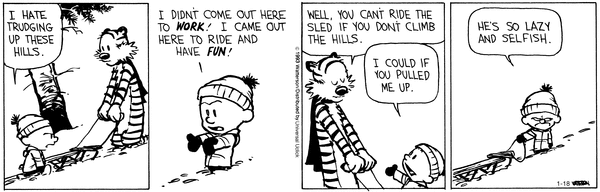
I've also found that every Calvin & Hobbes sledding strip is directly applicable to winter ultra events.
The best and kindest people I know have all suffered--be it voluntary or involuntary, physical or mental. I think suffering (voluntary or involuntary) makes people more attune to others' suffering (voluntary and involuntary). (Anecdotally, there are more vegans/vegetarians in this sport than other cross-sections of society.) I often say that, to finish these events, you have to find meaning in the suffering. There's a race (that shall not be named) with the motto, "Needless suffering without a point"--but maybe there is (or always was) a point. Maybe we're all better for it. Maybe the suffering makes us better people; not better than others, but better than our prior selves (or prior notions of self).
27 people started the 2017 v.2 Tuscobia 160 on foot. There were 47 registered, but the forecast turned cold, and a lot of people didn't show up. 6 finished.
Dare I say--it was a bit routine.
I mean, it was hard, but it was supposed to be hard. I'd gone over all the possibilities in my head prior to the race, and had either accepted the painful and terrible things that were going to come, or had prepared a solution for them (everything but beyond-basic injury). My hands were cold, but they're always cold. My feet hurt, but they always hurt eventually. My legs were cold, but that hardly matters. It took a long time (61 hours), but it was always going to take a long time. I wasn't going to win, but that's OK. The end seemed to never get there, but your brain does that at all of these races.
I never got too cold, or too far down. I could have run if I needed to--but I didn't need to. I could have stopped and eaten warm food that last possible time at Gateway and warmed up inside, but my kindred companion was too low to leave the trail, fearing never coming back out, so we kept on.
The thing I didn't expect: my deep and still-growing appreciation for these fellow sufferers, gracefully persevering right along with me--for seemingly no reason at all.
Why did we climb it? Because it was there.
But really, Paul Schlagel was in front of me, and not only did he do the Order of the Hrimthurs last year (and is 2/3 through again this year), but he did Moab 240, with ITI 350 as his reason for doing so (I too have ITI 350 in sight, but I doubt I want it more than Paul--the event, and the required time off from work, still scares me--maybe another year). I was in no hurry to try and catch him (not that I could have). And when I caught Dominique LaSalle after he stopped for 2 hours to take care of a biker in trouble at -25F just before the third morning, I wasn't going to leave him. That's my race. Simple as that. Dominique and I got 2nd. (I love that man. He said he's going to volunteer next year, but I don't believe him.)
You first, Paul.
The highlights of the race for me were arguing with Dominique and Logan Polfuss the first morning of this pointless thing--Logan and me screaming back and forth about tyranny, human behavior, and the common good--listening to Dominique belt out "I am the Model of a Modern Major General" at -20F in the middle of the second night, and Logan taking a 3+hour detour on his way home, just to have lunch with us. It all runs together--as if time floats away. We remember the highs and forget the lows, much like in life. We wrestle with our existence, and our reason for being. It changes us, or rather, we're the same people--the world is as it was--we just see it differently.
"People will forget what you said, people will forget what you did, but people will never forget how you made them feel." -- Maya Angelou
I think what draws and keeps me is the suffering, and the time devoted to a single task, where everything else in life doesn't matter--it all disappears. I only want to see my people, not because I need them, but maybe just to know they exist--that they're still here--that I'm still here. Because there is no guarantee they will be, or that I'll get there.
I've had this same conversation with Alex, but lying on the back of her sled.
You can't lie to yourself in these events. I know I've said that you should lie to others about how you feel ("When people ask you how you feel, and you actually feel horrible, lie to them. Tell them you feel great."), but I don't think that's actually lying to yourself--it's more just shifting your perspective. We have a normal range of comfort, and these events don't fit in that normal range--which actually means that, in your daily life, what you find uncomfortable probably isn't discomfort, in the grand sense of comfort. It's not that others have it worse, or have suffered more, but that your perspective is incomplete. These are paradigm-shifting events, and we're better for them.
We're better for the suffering--that shift in perspective expands your capacity for compassion, for kindness. Do enough of these, and your ego will be beaten down to the appropriate level of nearly non-existent. The hard, cold truth of the matter is that we're not special--we're not superior athletes, gifted with anything extraordinary--most people could do these things--we just suffered, and kept going. When we fell, we got back up. We've tried things above us, and we have failed. Then, we figured out why we failed, and tried again--and that's beautiful, but it's not unique to this sport.
"When I was young, I admired clever people. Now that I am old, I admire kind people." -- Abraham Joshua Heschel
All the best people I know have really suffered.
"What matters most is how well you walk through the fire." -- Charles Bukowski
The better you know it, the more you appreciate the suffering of others. You know that sometimes you can overcome it, but other times it'll be too much, and you'll fall apart. And the harder you hold on, the harder you'll fall.
Because we didn't fail today, doesn't mean we won't fail tomorrow. There's an amount of arbitrariness in life that we cannot escape. There's only so much we can control. The rest, we give into. We're just along for the ride. Appreciating that, the arbitrariness of it all, is humility. The world needs more of that.
I've been writing an injury-free running post for a while--it's a bit long, kind of an essay on running, actually. I don't know if it's good or bad that I didn't finish and post it before Tuscobia, seeing I've left that race injured two years in a row.
Gotta fix that.
Tuscobia is a wonderful event, put on by wonderful people, Chris and Helen Scotch and a slew of selfless, passionate volunteers.
I'm not a sailor, but winter ultra events remind me of sailing. There's a minimum complexity--if perfect weather and conditions, they're summer events with added gear. At best, it's a long, slow haul across the ocean. The perfect race is one of few waves and constant, steady progress. But like the unimaginable power of the ocean, weather and trail conditions can take what was a peaceful journey and turn it into madness.
"A ship is safe in harbor, but that's not what ships are for." ― William G.T. Shedd
Like walking a slackline, high above a canyon floor--it's that slim path of safety so close to danger on each side that draws people to it. It's climbing, one missed hold away from falling. It's about controlling what you can, and giving in to what you cannot.
I didn't know I was a thrill seeker.
Though my safety net is a bit safer than others--a sleeping bag and a spot device.
The race
The race started off well-enough, except that I accidentally found myself in front. I didn't even put on a headlamp until just a minute before we took off, and I hadn't planned on turning it on unless I needed something from my sled, yet somehow my 16-minute pace was leading. There was a few inches of new, wet, unbroken snow on the trail as we left Rice Lake, and it started snowing more as we headed north to the Tuscobia trail. I expected some idiot to run by at some point, but alas, I was the biggest idiot for the first 5 miles, breaking trail, until it got light.
When Scott Hoberg and I made quick stops a bit onto the Tuscobia trail, Carla Goulart and Kevin Alldredge scooted by for a second. They tried to sled the first hill, but didn't slide far, and Scott and I pulled ahead, Scott breaking trail for the next spell. At some point, Grant Maughan, from Australia, and Carla went ahead, running a bit. Scott followed, keeping them in sight. Even Kevin went ahead as I stayed at my 16-minute pace. Then, as the trail got hilly before Birchwood (mile 18), I kept pace past Kevin and Carla, before stopping at the first gas station for the bathroom and liquid.
I came back out to see Kevin and Carla just ahead, then Scott and Grant, who must have stopped at the second gas station. Still nobody in sight behind us. I made my way past Kevin, Carla, and Grant, and caught up to Scott. We had wonderful conversation, taking turns breaking trail. Grant stayed with us as Carla and Kevin fell off. Around mile 36, Scott stopped to check his feet, and Grant started running a bit. Scott went after him, and that's the last I saw him until mile 74.5. Grant eventually pulled out of sight, but he was at Ojibwe (mile 47) when I got there, and I left just after him.
I told Alicia, at Ojibwe, that I wanted to go quick, because I didn't want my right leg to tighten up--a sign of things to come. The night was uneventful, and lonely. The weather was good, and the trail ok. I was following Grant and Scott's steps, but was alone most of the night. My pace started to drop around mile 60--a combination of the pain in my right leg and sleepiness. The lone remaining 150 skier, Dan Powers from Alaska, caught me not too much afterwards, and I had new tracks to follow.
As the miles went on, the pain kept building in my right leg behind my knee. I wasn't able to fully extend it, or use my right calf or hamstring, but I could still push with my glute at a decent pace, so I kept on. A similar pain developed last year, though later in the race, and I was able to finish. I figured as long as I was able to keep my pace up, I'd be fine.
Soon, a single light started at me in the darkness, and Scott was on me. We talked briefly. He'd picked up the pace when he took off before Ojibwe, and hadn't slowed. At mile 74.5, he was 11 miles and a 45-minute break ahead of me. Amazing.
I got to the turnaround at Park Falls, mile 80, at 8:30am, 25.5 hours into the race. Dan, the 150 skier, and Grant, the Aussie, were sleeping. I fixed my feet, grabbed some warm water, and put my feet up for a few minutes. I took off again, just after Grant, but the right leg was slowing me a lot.
And that's about it.
I got back out on the trail and struggled to maintain a decent pace. It was ok, right away, especially as I passed the other 150-mile runners headed to the turn-around, and it wasn't long before the 75-mile bikers, skiers, and runners started by.
I had to put my parka on early because I couldn't keep my hands warm, then the wind picked up after dark, and the temps kept dropping. I told myself, "I can do this," a billion times, and I believed it, for a while, but the pain kept building, and I kept slowing down. Every few steps, my leg would move in a way it shouldn't, and the pain would blur my vision. I was tired, but the pain was exhausting.
At this point, around mile 103, I'd been moving at a paltry 27-minute pace the 23 or so miles since Park Falls, and I kept slowing. Doing the math, I'd be fine with even a 30-minute pace to the finish, but I couldn't fathom 26 more hours of wincing, vision-blurring pain. I came to a road crossing and checked my phone. No service. I kept going.
Logan Polfuss caught up, and I wasn't alone anymore. It was nice. We chatted a bit about the race, and life, and a few slow miles went by, but I was quickly losing the will to go on. We were 105 miles in, some 9 miles out from Ojibwe, and 4 miles from Winter, but I was done. The next road crossing came up, and I hit my non-emergency "come get me" button on my Spot device, tossed my sleeping pad out in the snow, pulled out my bag, and laid down. Logan joined me.
It was glorious.
Alicia and Kerry came and picked us up 3 hours later, and we crashed at a hotel in Winter.
By the time I woke up, Scott Hoberg had finished, and we made it to Rice Lake the next day in time to see Grant, the Aussie, finish. John Taylor and Thomas Keene, from Tennessee, each hung on to finish. 4 of 23 finished. The rest of us swung and missed, but that's ok, too.
He was born on a little farm in Wisconsin, a surprise as much to him as me.
He picked us, and that was the beginning and end of everything.
He went amazing places, and none of them mattered.
It didn't matter what we drove, where we slept, where we were going, or what we wore.
It only mattered that he was with us, and not without.
He taught us that happiness isn't a place, it's not a destination, or a thing, but a journey, only defined by who you travel with.
Travel anywhere, or nowhere at all, but do it together, and you have everything.
Tucker Sandor
December 5, 2004 - October 29, 2015
I wrote the below in September, after we learned we were losing him.
I'm thankful for every moment.
He was born on December 5, 2004.
He picked us in February, 2005; he wouldn't let us leave without him.
We walked him off leash right away, before he could even get away if he'd wanted to; he's never needed one since.
We learned quickly that he can't do kennels, but that hardly ever mattered.
When he was 2, he got a brother.
When he was 7, he lost him, and it was heartbreaking; he didn't understand what happened, and for months, he looked for him everywhere he went.
When he was 9, he got another brother.
He started as our pet, became our son, and over time, has become something even more than that; he's given us more than we've given him.
He's better and more compassionate than I am; I still learn from him every day.
He loves to travel, and hates being left behind.
He's been to 29 states.
He's seen Yosemite, Mt Whitney, and Death Valley.
He's been to Frozen Head in Tennessee, to Arrowhead and Tuscobia, to Leadville, Hardrock, and Western States.
He's climbed mountains, and strolled through Central Park.
He's seen Gettysburg, Niagara Falls, and Zion.
He's swam in Lake Tahoe and Superior, the Colorado River, Mississippi, Minnesota, and St Croix.
He became the wary acquaintance of a buffalo in Yellowstone, and picnicked at Jackson Lake under the Tetons.
He's hiked the Badlands, and Arches National Park.
He's walked through Times Square, and been on the Las Vegas strip.
He's run on the salt flats in Utah, and hung out in Colorado bars.
He's paddle boarded, kayaked, canoed, and boated.
He's spent countless nights and weekends with me in my office at work.
He knows when we're sad, and when we need someone to just be there.
He's the best friend I've ever had.
And he's dying.
And there's nothing we can do.
We've always known we wouldn't get to keep him forever.
Like everything else, he was never really ours.
But even though we know we'll have to say goodbye, we don't want to.
We never want to.
But he has an aggressive form of cancer.
It's everywhere.
And he's tired.
And he's scared.
And soon, his pain will be heavier than his hope.
And we'll have to let him go.
We don't know how much time he has left, when the days will become more bad than good.
But we do know how much he means to us, and that we owe it to him to keep his best interests in mind, and not be blinded by our own.
And we are sad.
And we are heartbroken.
And we will get worse.
And we will eventually be OK, but right now we're not.
We just want his last few days, or maybe weeks, to be wonderful.
Because what he's given us is beautiful.
And we wouldn't trade it for the world.